facebook

Pages

Thursday, August 26, 2010

TravelAid 2010: Rosanna - Clean Water Surveys

On the first Saturday during my time at JWOC a group of 4 of the TravelAid volunteers (myself included) and our respective interns attended the Clean Water Project. I had no idea of what to expect. The meeting at 7.30am was conducted in Khmer but JWOC staff were keen to elucidate about the project in English throughout the day.


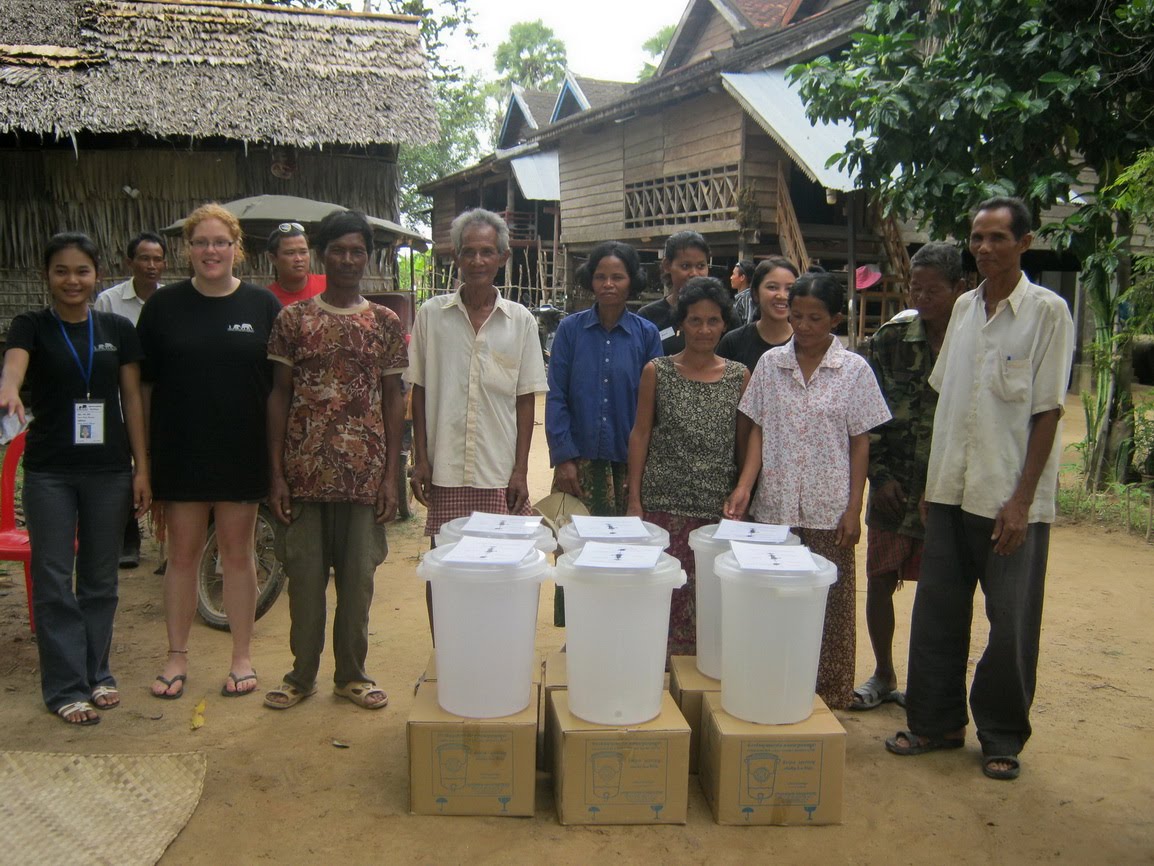
The first shock was getting on the back of the ‘moto,’ which was my first experience of such transport. Luckily all the JWOC interns drove us carefully and safely to the villages. The aim of the morning was to return to where JWOC had installed wells and filters 6 months before and to ensure the process was running smoothly and having the desired effects.


Nothing could have prepared me for the villages, which were a world apart from my life and home in London. The children’s behavior was in stark contrast to the children in Siem Reap or at JWOC, who are always keen to shout ‘hello.’ Instead many children cowered away from me or stood and stared at me - a JWOC officer informed me this was most likely because they had never seen a white person before. In addition I was overwhelmed by the accommodating nature of the people in these villages, who found a place for JWOC workers to sit. I felt rather intrusive walking into their lives and homes, but this didn’t seem to be a problem, I was pleased I had donned my JWOC shirt that day.


JWOC staff completed questionnaires while speaking to the same representatives of households and villages as they had spoken to 6 months ago, I found it curious that these were always women (most likely because there are the most reliable). The questions were also the same as 6 months before so that comparisons could easily be made. The questions concerned general information such as the number of people in the family and their monthly income! The monthly income of a family of nine worked out at $7.50 a month, this was a real shock to me considering I could easily spend that amount on a single meal or even drink!


Other questions concerned health such as stomach aches, fevers or diarrhea. JWOC staff informed me that the feedback we got showed a marked improvement since the wells and filters had been installed! It would seem that people had really taken on board what they had been shown. It was fascinating to observe how something such as clean water, something so taken for granted in the Western world, can make such a huge impact on the lives in rural Cambodia. I also observed marks on people’s body throughout the village which are circular burns of some description which I was informed is what the people do here if they are sick to rid themselves of ills. This seemed like extremely outdated medicine to my mind and placed the location I was in within a very real context.


As a geography graduate this experience animated years of study concerning ‘bottom-up’, but most importantly sustainable projects. The clean water project that I observed empowers the people of Cambodia both at JWOC and in the villages. It is now within the capabilities of these people to continue such a project and to run others elsewhere. I hope that JWOC continues to take such knowledge to other villages!

TravelAid 2010: Debbie F. - Clean Water Specialized Training


I sat next to a patch of ginger plants, shaded from the morning sun watching six village chiefs and heads of families being trained about good personal hygiene, how to use water filters and basic water pump repair by a group of university students and a well expert. It seemed a complete role reversal with the younger generation teaching the older but the training was interesting and engaging and everybody had a good time.


I was glad to see the filter training and well demonstration, as I saw a tangible change in the villagers’ lives. I wish I had the chance to revisit village in six months time to see how these changes had made a difference to their way of life.


I thought that I would feel awkward being the only non Cambodian person for miles around, but the people I met were so hospitable, getting me a chair to sit on and allowing me to see round the village. All I had were a few words of Khmer and the villagers had even less English, yet I felt welcome and was able to convey my gratitude. The language barrier – all the training was obviously in Khmer – made the whole experience seem very surreal, like I had fallen into another world. The countryside full of rice fields and water buffalo was among the most beautiful I have seen in South East Asia, and I feel so fortunate to have been able to see rural Cambodia for what it actually is, without tourists and commercial influence and to see a different side to the country. It really was a unique experience and I have to thank all the staff at JWOC for making it happen.


TravelAid 2010: Saras - Microfinance

Many things have taken me by surprise here at JWOC. I never thought, for example, that I would find microfinance so interesting. In fact, before coming, I wasn’t even sure of what it entailed. In simple terms, it can be thought of as lending money, something that’s quite sequestered from the traditional image of charity work, but the microfinance project at JWOC is much more than that, it is about empowering entrepreneurs in a small community.


JWOC lends money to people in villages throughout an ever expanding area - these are people who have promising ideas, or are looking to grow an already established business and support their family. The borrowers would not usually be able to acquire an accredited bank loan, for various reasons, such as not being able to do the hefty paperwork, or not owning any collateral.


The loans are given with a large dose of trust, as JWOC does not take action against failure to repay, but measures are set in place to minimize this, such as loans being given out to groups with one member being a leader that deals with the individual finances, and incentives for those who pay back.


One afternoon at JWOC, I had the opportunity to work for the microfinance department, consisting almost totally of JWOC’s scholarship students who volunteer as part of their sponsorship through university. I went with a team to a nearby village, to collect repayments from two group leaders.


The first house we arrived at, we were greeted with great welcome and gracious hospitality. Once sat down and comfortable, we talked about the business. This particular entrepreneur was a middle aged lady, who had bought a sewing machine with her loan, after learning how to make tote bags on a course with another charity. I was pleasantly surprised by their quality, something I could definitely see myself buying for a friend. She used unconventional materials such as clear plastic and shredded newspaper and sold the stylish bags on to a large organization that gave her a modest sum of money, but nevertheless, allowed her to support her family and live comfortably.


Yet again, we were met with smiles and welcomes upon our arrival at the second house. Looking around, I saw a water filter provided at a large subsidy by JWOC, a perfect example of how JWOC ties in its various projects merging microfinance with clean water and, whilst handing out a loan, educating people about hygiene and good health. This businesswoman had chosen a more conventional route to take and had a small grocery vending business within her house. She used the loan from JWOC to buy in supplies for the shop. Business seemed to be going well and yet again, it was a humbling experience talking to someone who was so grateful for a sum of money that I may have once wasted on a family holiday.


Travelling back to JWOC headquarters I had time to reflect upon the trip. Both businesswomen had used every cent of their money to its maximum potential, and in doing so they could support their families, maybe provide education to their offspring, good food and nutrition, etc. Moreover, they were happier, had prospects and goals, and had the opportunity to join the next loan cycle from JWOC - who knows what they will do with the money. A little bit of capital can go a long way, not just in providing sustenance to a small group of people, but in allowing enterprise to flourish, small economies to thrive, and in providing the first rung of the social mobility ladder.

TravelAid 2010: Lucia - Dance Activities


It was the 3rd of August and the day before our first session of morning activities for the children. I found myself, alongside two other volunteers and three Cambodian High School interns, trying to brainstorm a dance lesson for an unknown number of children of an uncertain age range. As the activities camp was entirely optional children from the surrounding areas, they could turn up if they so wished. This meant the numbers of children per day were never certain. We decided to do a fusion of Khmer and Western dancing, it took us far longer to learn the Khmer moves than it did to teach the interns English favorites such as the Macarena. The next morning we nervously performed this eclectic mix to a group of about thirty rather bemused children, who found our attempts at Khmer dancing utterly hilarious. Their undisguised disdain was a blow to my ego, I rather fancied myself as a dancer, but it worked well as they then felt little embarrassment at getting involved, I believe their attitude was that they could never be as bad as us! One group of five ‘lads’ was particularly disconcerting as they watched the entire performance leaning casually against a wall, eyebrows raised; little did I know they were to become my most avid followers! To our surprise and delight after their rather unimpressed faces they really enjoyed learning the dance. We had expected the dance to take up the bulk of the lesson, it took them about fifteen minutes to learn a dance which had taken us an hour and a half to choreograph, they were far faster learners than we had been!


Each night we choreographed increasingly complex dances designed to be taught in a forty-five minute session after various warm up games. We drew inspiration from pop music bands and the snippets of their routines that we could remember; juxtaposing ‘Grease lightning’ with ‘S club’ was surprisingly effective! The speed at which the children learnt the dances never ceased to amaze me, they were far more adept than many of the volunteers who struggled even with the Macarena!


We thought the youngest group, composed of children between two and five, would probably struggle to learn a choreographed routine, so instead we played a variety of games, including musical bumps, and sang countless songs-the ‘Hokey Cokey’ became a favorite with all age groups! Even in this age group there were several children who impressed everybody with their moves!


There was nothing that made me happier than seeing groups of children practicing their dances after class. The ‘lads’ who had caused me such worry at the beginning would argue over which pop dance was the best, perfect each others’ moves and be the first in the dance classroom each day. They turned out to have a surprisingly wide repertoire of dance styles including break-dancing and moon-walking.


We tried to incorporate some drama into our sessions, and managed to weave dance together with the theme of ‘the environment’. We composed an interpretative dance about deforestation which included break-dancing trees (having learnt some moves from the ‘lads’), balletic hungry animals and the evil ‘bad man’ who cart-wheeled onstage and proceeded to cut down all the trees.


We also taught the children a few Scottish dances, although the reluctance of boys and girls to pair up made this rather tricky. I loved watching the childrens’ faces of intense concentration as they mastered each new dance. The sight of thirty Cambodian children dancing a medley of pop songs was a strikingly bizarre, and yet extraordinarily rewarding sight! I like to think the children enjoyed it, I most certainly did!

TravelAid 2010: Sarah - Sport Activities


From a very young age I have played sporty type games with parents at home and friends in the playground so was really keen to do some sport sessions within our activities camp. Entertaining the younger ones with games out on the dirt field was easy and great fun – anything that involved lots of energy and competition was a hit! Nowadays nearly all sport that I take part in back home is very structured and rule based so I was initially quite surprised at how difficult it was to get the older ones to get involved and enthusiastic about structured sport. The boys were happy just playing football all the time but it was especially difficult to get the girls to participate in large matches of volleyball, football or dodgeball. All loved the running/tag based games but they were clearly not used to being asked to play sport matches as part of a large team.


I was especially surprised when I tried to get a game of volleyball going with just the girls, that, despite it being one of their national sports, most were not interested and had clearly never really played it before. In the end we found it best to build up to ball sports gradually by introducing a ball or bat into relay races or fun games. They seemed to really get into these and the girls even managed some simple netball drills, although some, which I thought were quite natural and easy, were clearly very foreign to them! By the end we were able to get everyone involved in a dodgeball match and even tried rounders once. However, playground type games such as bulldog, cat and mouse and stuck in the mud always proved the most popular – perhaps because they are most similar to Cambodian games of which we were taught a few and were always a great laugh.


Blogger news

Blogroll