facebook

Pages

Monday, March 06, 2017

Back to School - Sylvia's JWOC Experience

I come from a normal family in Hong Kong and I worked in the hospitality industry.  Last year, I came to Siem Reap as a tourist and I met a JWOC Scholarship Student graduate at a boutique hotel – it was then that I first heard about JWOC and the work they do.
Despite the country’s tragic history, I was touched by the kindness and smile of Cambodians – the thought of returning to this place has clung to my heart since then.
“It is more blessed to give than to receive.” While we are receiving all-rounded education in Hong Kong, and working very hard to earn a living; there are people in Cambodia who have a thirst for knowledge, but struggle to find work because there is little chance to study.  Education is the requisite for becoming self-sufficient and creating future leaders here. 
I was assisting a team of passionate teachers in the Free Classes (supplementing to their usual classes at Public Schools) over the past few weeks.  I did enjoy it very much! The kids are innocent and willing to learn.  They simply made me smile every time when I enter JWOC. Seeing them reminds me to always show appreciations and be humble – instead of taking things for granted!
Thank you JWOC team for all the hard work and love! 

Tuesday, February 14, 2017

Creativity in the Classroom: JWOC Teacher Development Workshops


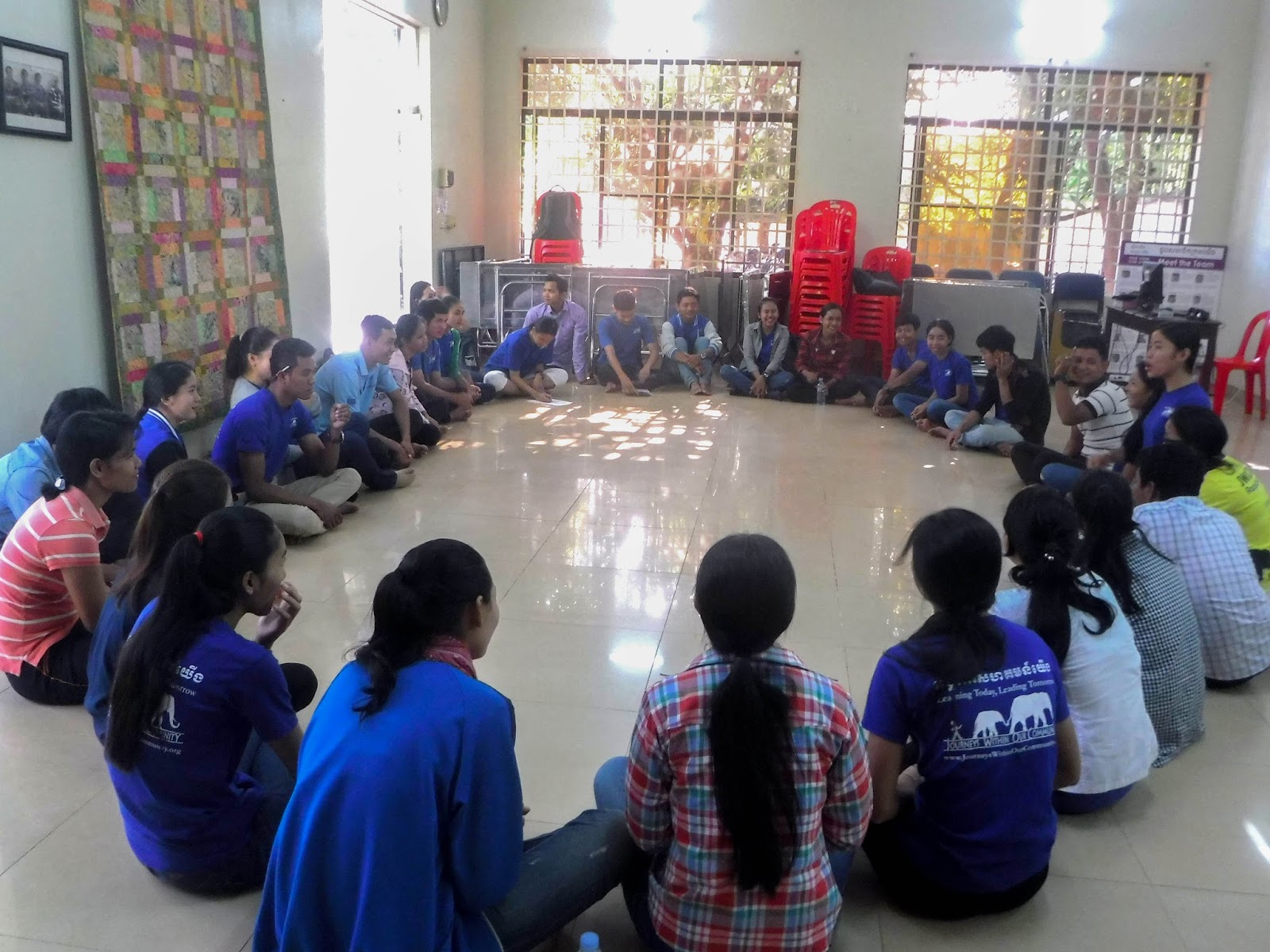
The Free Classes' February Teacher Development Workshop took place on Sunday 5th Feb. Led by JWOC's Child Development Coordinator and Librarian Sonesa Khuon, it focused on 'Facilitation Skills using Creative Art Techniques', we caught up with her to find out how it went.

Please can you describe the training that you did in today’s teacher development workshop?
The training in today’s Teacher Development Workshop was named ‘Facilitation Skills using Creative Art Techniques’. As art class team leader and library class teacher the training can help our scholarship student teachers to build ideas, think creatively and in turn apply such skills into their lessons and classrooms. I focused on sharing methods to build closer relationships between teachers and students (and scholarship student peers), from what I saw the students enjoyed the training, finding it interesting, meaning they can apply it in the classroom.

What methods did you use in the training to support your class?
To start, I asked all students to stand in a circle, stand next to a member of the opposite gender before asking them to hold hands. They felt shy and awkward, but I did this to break barriers and to get them to better know each other. We played the ‘name game’, so everyone knew each other’s name, more than 60% already knew each other. Such games are very good in building up relationships in the classroom, especially as the new term starts and students don’t know each other. Beside games, I asked them to meditate and to think about the teachers (in school and university) they liked and disliked and then what those teachers did right and wrong. This reflection allowed them to realize how they act in the classroom and to understand what they should do to ensure their students enjoy learning with them. This is great way for the students to reflect in a peaceful environment, something most had not done before.

Why is creativity in the classroom important? How do you think it will help the teachers in the classroom and the student’s learning?
Creativity in the classroom is very important as it helps the teacher to introduce new techniques and make the lesson more fun and engaging. It is a modern teaching method practiced in more developed countries. It helps teachers to teach in different styles and make the lesson more interactive so students will not feel bored with the same kind of lessons.

How can the teachers encourage creativity in the classroom?
There are many ways, including playing games, teaching them through songs, changing the classroom layout; as well as different styles of teaching through textbooks, projectors/slideshows, tablets, and changing the classroom environment (teaching inside and outside) etc. These are just a few that we discussed.

Why is creativity important for the next generation of Cambodians? How will it help Cambodia grow?
It is very important for the next generation of Cambodians because it is a new strategy for students and teachers to participate in the learning process. Students will learn through having fun, making the class more interesting, building skills in communication, collaboration, creative and critical thinking. This will help Cambodia grow by making a more reliable human resource which has more creative skills to help people in communities, encouraging innovation and helping Cambodia to develop faster. 

Tuesday, January 03, 2017

STEM @ JWOC: Students present Science!

On December 18th JWOC’s Science students showed their ability and confidence by completing their Science presentations. Topics included Plants, the Environment, Astronomy and Nutrition. At such a young age, students were very brave to stand up in front of their peers and parents show off what they had learned and their favourite science topics. Students had been practicing their presentations over the previous weeks, building their skills and confidence. After each presentation was complete, the students took questions from the audience about their topic, this gave them a chance to show off their extra knowledge on the subject and make sure the audience understood everything.

Parents were very proud of their children and commented on how impressed they were that children were able to present and to show respect to the teacher and audience; they rarely had a chance to see their child’s learning in action.

Science teacher Nesa observed: ‘I’m very proud, I don’t just want them to sit on their seat, I want them to present their work!’ 


Monday, October 24, 2016

Brainpop comes to JWOC

Written by Sarah Thompson (JWOC's Education and Volunteer Manager)
The Brainpop app is still being actively used in our Free Classes Program here at JWOC since the licence was kindly donated to us 6 months ago, through tablets generously donated to us through Team4Tech! Scholarship Student teachers Kimchhay, Dany, and Sitham play an active role in training other scholarship students and volunteers on how to use Brainpop to the best of their ability in the classroom. Kimchhay conducted a Brainpop workshop during our monthly teacher development workshops last May and has since encouraged the Free Classes teachers to integrate it more in their lessons as a supplemental tool. 


Many teachers we spoke with enjoy using it with adults and expressed the feeling that Brainpop visuals and videos can help the teachers better explain a difficult grammatical idea or concept. One teacher said, "I am talking about the visuals on the tablets which is very attractive for students to involve with our lessons. All videos are relevant with daily life activities so the students could catch the meaning even more than explaining by examples." Another teacher commented that Brainpop provides extra grammar ideas and has funny games that are stimulating for the students. The quiz sessions are also helpful to reinforce difficult grammar concepts and allows the teacher to check that the students are actually understanding and retaining what is being taught. 


While Brainpop is an excellent additive here at JWOC, a few teachers still are not very confident in using it to complement their lesson plans. Technology usage is slowly integrating into different aspects of Cambodian society and we are working to ensure that they are comfortable integrating it in their lessons by focusing on more Brainpop training in our teacher development workshops. Introducing new technology in the classroom can be difficult for students with no tech background, however, here at JWOC we believe building their IT capacity and pushing them to use new tools will better prepare them for the future and allow them to become even better educators.

Monday, August 15, 2016

Vantha's Scholarship 101: How does the JWOC Scholarship Program really work?

Hello, my name is Vantha Kuon. I’m the Scholarship Program and Office Manager and I’ve been working with JWOC since 2009; It has been more than 7 years now, but it still seems like yesterday to me. In 2009 I started with JWOC serving as a Bookkeeper and project assistant. At that time, I assisted in all JWOC project activities when they required my help, working in and outside the office with the local community. It was my first experience working within an organization; it was my dream job when I was studying at high school!
I am extremely excited to be a part of all of JWOC’s programs, especially scholarship program; I am lucky enough to see how the program can change the students’ life for the better. From working with them when they start their scholarship as they enter the big wide world, to helping them face life’s many problems, to understanding the value of working and giving back to their community before graduating.
What each student can learn, what they can share and what they can do for their community through JWOC’s programs makes them feel the words “Learning today, Leading tomorrow” in their hearts. They not only support their community but also their nation.

I would like to share with you the scholarship recruitment process so all of you can see how JWOC is taking on new students who need help from us to achieve their future dreams. The JWOC scholarship program is open for all students from both in Siem Reap and other Cambodian provinces. 

We make announcements to the local high schools, NGOs, in different districts of Siem Reap, through our social media and old and new JWOC operating areas. The students who wish to apply will come and collect the application forms for themselves and for their friends and relatives. We also put the application form online so it can reach those students who may face difficulty in travelling to JWOC as they live far from Siem Reap city. The application form includes questions that give us information about their family, education, career experience and their dreams.

The application forms and subsequent interviews are the first opportunity for JWOC to get to know the student’s ambitions in depth and to see which applicants require a scholarship to help them grow and have the willingness to give back to our local community. To just see their application would not be enough for us to decide which students are suitable and need help from us, so we meet face to face and understand their real motives and ambition to further their education and careers. We then talk to their references; these can include their village chief (who knows/understands their family background and current situation), their teacher and/or their employer to gain an understanding of their attitude and characteristics towards working. The final step of the process is visiting the student’s family in their home town; this ensures we are definitely handing the opportunity to the right students and families.

You can see photos from our scholarship program recruitment process below:
Scholarships are advertised in local villages
Interviewing an applicant at JWOC
On the way to a home visit
Meeting with the student's family
Another family visit
Being a JWOC scholarship student means not just the chance to study at university but also to receive support and capacity building to develop knowledge and skills as well; examples of training we conduct include: personal goal setting, using the internet efficiently, career training (how to find a job, CV writing and interview techniques, stress management).We also work one on one with each student to provide personal problem consulting, helping them to stand up and deal with any problems (whether in university or elsewhere) and make sure they do not give up! 

This extra support really helps them to become stronger and stronger from day to day, molding them into adults and helping them to fit into the job market. Everything that we do in our scholarship program tries to make our students feel as though JWOC is their second home and family; we always stand behind them and support them.  

 
Over the past 10 years we have had 123 students graduate from our scholarship program, these students have gone on to all manners of success in their life. Some students continue to give back to their community through their personal careers and businesses, others are working in the education sector as teachers and school directors to share their skills and knowledge with the next generation, and some are working in different types of NGO, helping their community through their programs and others are working in the different sectors.

JWOC’s Local Advisory Board was formed in 2015 and is made up of our scholarship alumni; they meet with us every quarter to spend their valuable time to work with and connect JWOC and our scholarship students with real opportunities for growth throughout the Siem Reap community.


I, myself really don’t have the words to describe the value that our Scholarship program is giving to the community and the amazing support of each and every sponsor. This approach is really a transformative opportunity that teaches people how to support themselves, their family and their community, not just a handout for them to live. This really inspires me to continue working hard with scholarship program so I can see my people and my community develop and grow.
On behalf of current and graduated scholarship students, I really appreciate all the support from our sponsors; it means so much to all Cambodian students and communities. All of this would not be possible without your support.


Blogger news

Blogroll