facebook

Pages

Thursday, October 28, 2010

Xin Yuan - October 2010: Clean Water Project

As part of our Company’s Corporate Social Responsibility program, our company selected four volunteers to help out in the Clean Water Project with JWOC for 6 Days. I was fortunate to be the team of volunteers to have the opportunity to contribute. I arrived in Cambodia on 19th October 2010 and immediately we made our way to JWOC Headquarters in Siem Reap. I was greeted by Andy and Camilla, the Managing Directors of JWOC. They gave us a briefing on Clean Water Project and touched on the issues faced by the villagers. We were given a schedule for our volunteering roles over the past few days.


The following morning, we were picked up from our guesthouse to help out in the construction of Bio-Sand Filters (BSFs). It was something new for me as I have never tried pouring concrete or doing anything similar. At the end of the day, although my hands were blackened with grease, oil and concrete, my heart was filled with simple contentment.


The next day, we started out early from our guesthouse. Sokhorn, JWOC’s Clean Water Project Manager, picked us up and drove us and 17 boxes of donated items we had brought with us from our guesthouse to JWOC for sorting in order to ensure the items were distributed in a fair, calm and organized way. Andy explained that JWOC’s clean water project relies on fair and equal distribution of all the resources offered. Therefore, JWOC must ensure therefore that all the benefits given through a JWOC project are shared out equally or it would risk jeopardizing the other aspects of the project. I was sincerely touched by Andy’s opinions on this matter and it clearly shows his dedication.


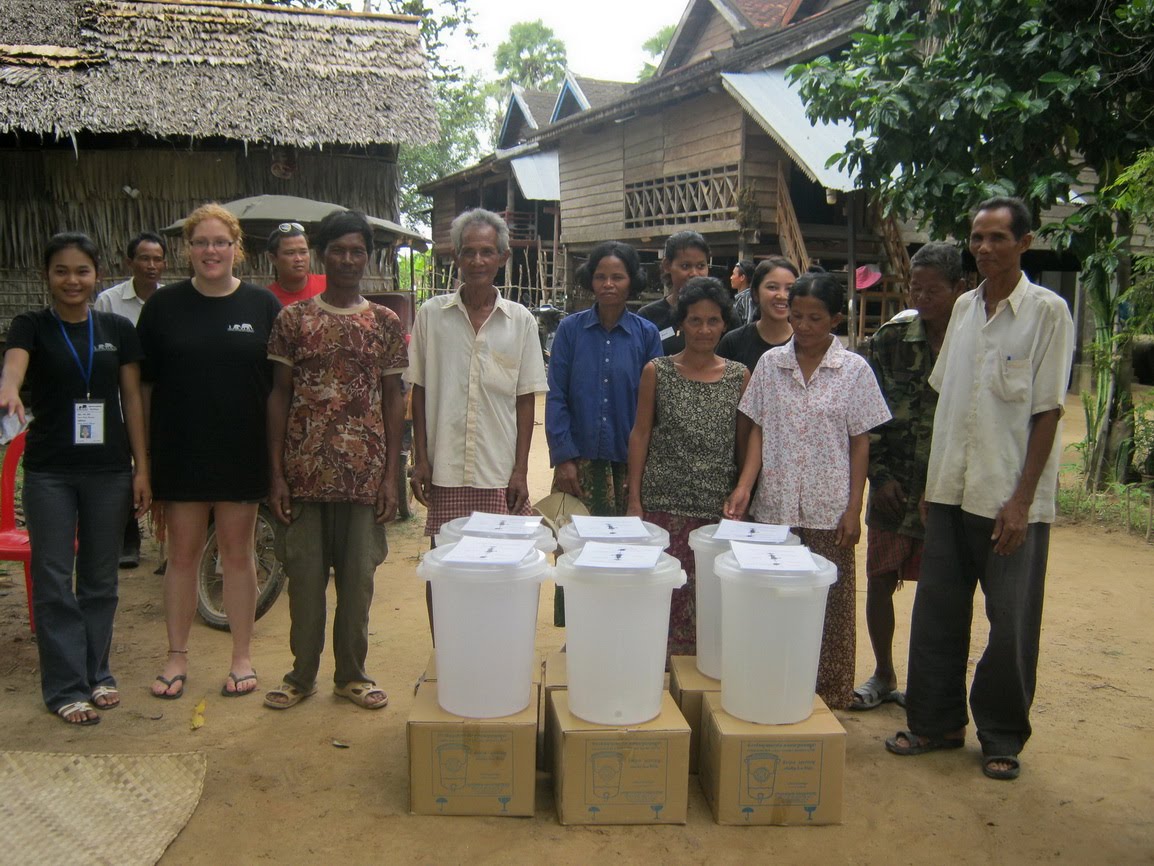
After delivering the items at JWOC, we had our first trip up the Knarong Veas village to assist in the distribution of the BSFs and an educational seminar to teach the villagers how to use it. Along with Monnoreth – a JWOC scholarship student and Clean Water officer - my colleague and I delivered the BSFs to three homes using manual carts. The BSF organisation sent their employees to assist the villagers in installing the BSF. While installing the BSF, I spotted a well next to the house. Sokhorn mentioned that well was shared by many families around and most villagers had to walk several kilometers just to get their water. In addition, during the dry season, the villagers could only get a limited water supply from the well. He pointed out that with our company’s financial support for well construction and BSFs, the villagers will have much greater access to clean water even during the dry season.


On the following day, we went back to the village to help out with well construction. When we arrived, the well was already drilled and the local construction company has already begun the work. I helped out with screwing the bolts to secure the water pump base and to lay the bricks. Although the bricks I have laid were not a pretty sight and the local construction workers had to do remedial works on the bricks, I was satisfied that I was able to contribute. In the afternoon, we left the well construction to the trusty hands of construction professionals and made our way to the Knarong Veas Elementary School to give out vital supplies to the children including their core school textbooks, stationary and other items.


At the Elementary School, we did a Q&A session with the students on topics such as malaria and personal hygiene. We asked the questions in English and Sokhorn translated it into Khmer language for the students. I heard so many enthusiastic *wooooo* whenever we gave out soft-toys to children who answered correctly! We ended the experience at school by giving each student 3 brand new textbooks and either stationary or soft-toys depending on their grade level. The stationary and soft-toys came from donations from our colleagues and another Singaporean lady.


It was a heartwarming experience to see the beaming smiles of these kids.


On the last day of the volunteering trip, we were split in three groups to conduct Hygiene Seminars and distribute the clothing donations to the villagers. Sokhorn tasked me to take photographs during the Seminar and to distribute the hygiene packs and clothing donations. I was grouped with three Scholarship students and another of my colleagues.


Miss Ra Ya delivered a witty and engaging presentation for the villagers. It was heartening to see all the villagers coming to the Hygiene Seminar and for them to participate actively in the answering questions and doing demonstrations. When we handed out the hygiene packs and clothing donations, I was so touched when the villagers thanked us profusely. There were some villagers who immediately put on the clothing and admired each other’s new outfits!


The time I have spent with villagers may have been short but they have warmed up my heart. Their genuine smiles and “Or-Kun” (Thank you in Khmer Language) made my trip completely worth it. The trip realigns my mission and purpose in my life. I will definitely be on more of such trips to serve the community.


Thank you JWOC for giving such a life-changing experience and I hope the best for Andy, Camilla and all staff at JWOC in their mission to improve Cambodian lives.

Thursday, August 26, 2010

TravelAid 2010: Debbie


Arriving at JWOC on our first day we really had no idea what to expect. Following Andrew into a modern complex I was incredibly surprised to see how developed JWOC was, despite being a relatively new charity. Essentially none of us were entirely sure what we would be expected to do. Camilla, however calmed our nerves with a clear explanation and my anxiety rippled into waves of excitement.


Of course, the highlight of my first day was meeting my intern. Sokim seemed sweet and polite and, most importantly, eager to start! Games with the JWOC staff helped break the ice since we felt as ridiculous as each other. I think it’s safe to say day one at JWOC left us feeling relieved – we knew amusing children and teaching English for four weeks would be challenging, but judging by the welcome we received we also knew we would enjoy it massively. I grew to appreciate how JWOC was a quietly busy place to be- there was always something to do. The nine of us really had to rack our brains for enough ideas to occupy children everyday and there were times I felt extremely disheartened when they didn’t work but I think that despite the cultural and linguistic barriers, in the end, kids will be kids and they mostly had lots of fun.


Sokim and the others were indispensible in the activity camps- not only for translation but for bringing their talents to the class (especially Kuemhong and his dancing). Developing a bond with the interns has definitely been one of my favourite aspects of our time spent here- through the activity camp and other projects we have grown closer and dare I say, become friends.


And my entry could not possibly be complete without a mention of Phong. The vision of him toddling on the grass with a t-shirt matching our own made us all fall in love with him.


So I guess the last thing I have to mention is a massive thank you to Andrew, Camilla and the rest of the JWOC staff for giving us this amazing opportunity and unforgettable experience.


TravelAid 2010: Rosanna - Clean Water Surveys

On the first Saturday during my time at JWOC a group of 4 of the TravelAid volunteers (myself included) and our respective interns attended the Clean Water Project. I had no idea of what to expect. The meeting at 7.30am was conducted in Khmer but JWOC staff were keen to elucidate about the project in English throughout the day.


The first shock was getting on the back of the ‘moto,’ which was my first experience of such transport. Luckily all the JWOC interns drove us carefully and safely to the villages. The aim of the morning was to return to where JWOC had installed wells and filters 6 months before and to ensure the process was running smoothly and having the desired effects.


Nothing could have prepared me for the villages, which were a world apart from my life and home in London. The children’s behavior was in stark contrast to the children in Siem Reap or at JWOC, who are always keen to shout ‘hello.’ Instead many children cowered away from me or stood and stared at me - a JWOC officer informed me this was most likely because they had never seen a white person before. In addition I was overwhelmed by the accommodating nature of the people in these villages, who found a place for JWOC workers to sit. I felt rather intrusive walking into their lives and homes, but this didn’t seem to be a problem, I was pleased I had donned my JWOC shirt that day.


JWOC staff completed questionnaires while speaking to the same representatives of households and villages as they had spoken to 6 months ago, I found it curious that these were always women (most likely because there are the most reliable). The questions were also the same as 6 months before so that comparisons could easily be made. The questions concerned general information such as the number of people in the family and their monthly income! The monthly income of a family of nine worked out at $7.50 a month, this was a real shock to me considering I could easily spend that amount on a single meal or even drink!


Other questions concerned health such as stomach aches, fevers or diarrhea. JWOC staff informed me that the feedback we got showed a marked improvement since the wells and filters had been installed! It would seem that people had really taken on board what they had been shown. It was fascinating to observe how something such as clean water, something so taken for granted in the Western world, can make such a huge impact on the lives in rural Cambodia. I also observed marks on people’s body throughout the village which are circular burns of some description which I was informed is what the people do here if they are sick to rid themselves of ills. This seemed like extremely outdated medicine to my mind and placed the location I was in within a very real context.


As a geography graduate this experience animated years of study concerning ‘bottom-up’, but most importantly sustainable projects. The clean water project that I observed empowers the people of Cambodia both at JWOC and in the villages. It is now within the capabilities of these people to continue such a project and to run others elsewhere. I hope that JWOC continues to take such knowledge to other villages!

TravelAid 2010: Debbie F. - Clean Water Specialized Training


I sat next to a patch of ginger plants, shaded from the morning sun watching six village chiefs and heads of families being trained about good personal hygiene, how to use water filters and basic water pump repair by a group of university students and a well expert. It seemed a complete role reversal with the younger generation teaching the older but the training was interesting and engaging and everybody had a good time.


I was glad to see the filter training and well demonstration, as I saw a tangible change in the villagers’ lives. I wish I had the chance to revisit village in six months time to see how these changes had made a difference to their way of life.


I thought that I would feel awkward being the only non Cambodian person for miles around, but the people I met were so hospitable, getting me a chair to sit on and allowing me to see round the village. All I had were a few words of Khmer and the villagers had even less English, yet I felt welcome and was able to convey my gratitude. The language barrier – all the training was obviously in Khmer – made the whole experience seem very surreal, like I had fallen into another world. The countryside full of rice fields and water buffalo was among the most beautiful I have seen in South East Asia, and I feel so fortunate to have been able to see rural Cambodia for what it actually is, without tourists and commercial influence and to see a different side to the country. It really was a unique experience and I have to thank all the staff at JWOC for making it happen.


TravelAid 2010: Saras - Microfinance

Many things have taken me by surprise here at JWOC. I never thought, for example, that I would find microfinance so interesting. In fact, before coming, I wasn’t even sure of what it entailed. In simple terms, it can be thought of as lending money, something that’s quite sequestered from the traditional image of charity work, but the microfinance project at JWOC is much more than that, it is about empowering entrepreneurs in a small community.


JWOC lends money to people in villages throughout an ever expanding area - these are people who have promising ideas, or are looking to grow an already established business and support their family. The borrowers would not usually be able to acquire an accredited bank loan, for various reasons, such as not being able to do the hefty paperwork, or not owning any collateral.


The loans are given with a large dose of trust, as JWOC does not take action against failure to repay, but measures are set in place to minimize this, such as loans being given out to groups with one member being a leader that deals with the individual finances, and incentives for those who pay back.


One afternoon at JWOC, I had the opportunity to work for the microfinance department, consisting almost totally of JWOC’s scholarship students who volunteer as part of their sponsorship through university. I went with a team to a nearby village, to collect repayments from two group leaders.


The first house we arrived at, we were greeted with great welcome and gracious hospitality. Once sat down and comfortable, we talked about the business. This particular entrepreneur was a middle aged lady, who had bought a sewing machine with her loan, after learning how to make tote bags on a course with another charity. I was pleasantly surprised by their quality, something I could definitely see myself buying for a friend. She used unconventional materials such as clear plastic and shredded newspaper and sold the stylish bags on to a large organization that gave her a modest sum of money, but nevertheless, allowed her to support her family and live comfortably.


Yet again, we were met with smiles and welcomes upon our arrival at the second house. Looking around, I saw a water filter provided at a large subsidy by JWOC, a perfect example of how JWOC ties in its various projects merging microfinance with clean water and, whilst handing out a loan, educating people about hygiene and good health. This businesswoman had chosen a more conventional route to take and had a small grocery vending business within her house. She used the loan from JWOC to buy in supplies for the shop. Business seemed to be going well and yet again, it was a humbling experience talking to someone who was so grateful for a sum of money that I may have once wasted on a family holiday.


Travelling back to JWOC headquarters I had time to reflect upon the trip. Both businesswomen had used every cent of their money to its maximum potential, and in doing so they could support their families, maybe provide education to their offspring, good food and nutrition, etc. Moreover, they were happier, had prospects and goals, and had the opportunity to join the next loan cycle from JWOC - who knows what they will do with the money. A little bit of capital can go a long way, not just in providing sustenance to a small group of people, but in allowing enterprise to flourish, small economies to thrive, and in providing the first rung of the social mobility ladder.


Blogger news

Blogroll