
For his post this month Free Classes Project Manager, Somit, decided to make a video to explain the need for and the benefits of his project. Watch the video to find out more-
You can also get more details about the Free Classes Project here.
Friday, June 24, 2011
Monday, June 06, 2011
Hygiene Training in Doun Keo
As part of the Clean Water Project we carry out hygiene training in each village we work with. The last three weeks have been training time in Duon Keo, our latest village partner. We got great levels of attendance and it was also an opportunity to test out some recent revisions to the training sessions.
Look through our pictures to learn more...

The training sessions take place in any open spaces in the village- though trees are always a welcome feature for the shade they provide. Here we can see Project Manager Sokhorn starting the teeth-cleaning session.

One new feature of the adults' training sessions is a temporary creche which allows the parents to concentrate on the messages and activities. The little ones get to complete hand-washing colouring sheets and play games.

The props and interactive nature of the training sessions make them fun and memorable.

One of the changes to the teeth-cleaning session was to introduce actions to help the participants remember the steps. Here we can see children doing the "up" part of the "up, down and around" routine.

Another one of the changes was the use of flashcards during the session. These pictures help explain ideas and also aid memorisation of the messages.

After the sessions everyone receives a 'hygiene pack', so they can put the training into practice straight away- increasing the chances of creating new habits.
To learn more about the Clean Water Project and what other activities take place in each village visit this page.
Look through our pictures to learn more...


To learn more about the Clean Water Project and what other activities take place in each village visit this page.

Friday, June 03, 2011
A short Microfinance story
Meet Kim...

Kim is originally from Takeo Province but has lived in Siem Reap for most of her adult life. Since her husband left her a year ago she has been living with her daughter’s family. The picture above shows her with one of her granddaughters.
The money she earns from selling traditional rice cakes goes into the household fund to pay for food for the family.
The small loan Kim received from JWOC enabled her to buy a bicycle meaning she can cover more distance each day and sell more cakes.
She says being able to contribute more to the household fund has two benefits- the family have more to eat and can save a little money for emergencies and importantly, she feels better about herself, more proud.
For Kim, the $50 she borrowed from JWOC made a big difference to her daily life. If you would like to help other families in Siem Reap please donate $10 or whatever you can afford...
Wednesday, June 01, 2011
Learn more about the Lao school system
This post is a little different as it is hand written. Somdith, a student at JWOC's Language School in Muang Nga, Lao PDR, has written this mini-essay about the school system to share with you all. Click in the picture to make it bigger. Apologies for the scanning- I hope you can read Somdith words!

To read more about how JWOC supports Muang Nga School click here.

To read more about how JWOC supports Muang Nga School click here.
Sunday, May 29, 2011
Volunteering in JWOC's Free Classes
Read about Kaitlyn's experience as a Free Classes volunteer and the difference it made for her and the students she met...
Define the word helicopter. Use only the simplest English vocabulary. Do not rely on the use of illustrations as an aid. Remember that the education of a group of five young students lies temporarily in your hands. It is not easy. Sitting in a classroom enveloped in the rush of humidity that follows an afternoon shower, ten fervent eyes fixed solely on their volunteer instructor, I had the task of defining “the flying machine with a spinning fan on top.”
The obstacle of defining several words that I take for granted in my everyday vocabulary was presented to me when I signed up to volunteer at one of Journeys Within Our Community’s (JWOC) conversation courses. During this time students are encouraged to attend and improve upon their English speaking skills. Unlike in America and other developed countries, in Cambodia the prospect of a sufficient education is not a right afforded to every young person. Public schools are inadequately staffed and underfunded. Students who wish to receive a proper education must seek out instruction elsewhere. This is where JWOC comes in, providing free classes for people of all ages in various subjects including the two I volunteered for, English conversation and art.
I have had a firm grasp of the English language since I mastered “Hop on Pop” in my pre-K years; however, I have never attempted to teach my native tongue. It was much harder than I ever could have imagined. After being placed in my small group I found my hand trembling as I filled in the correct answers on my worksheet. Fears of being a bad teacher suddenly seemed very real and all of my English speaking abilities left the room. At the moment of utmost panic one student looked at me and asked a question that immediately made me realize why I had come to that classroom.
“Can you read it to me? I want to hear all the words.”
This was something I could do. For the first time since entering the country I did not feel like a tourist, unaware of the lives unfolding all around me. I yearned to help these students to the greatest of my ability. Driven to this place of learning by their own desires, not by outside force, these young adults represent the heart of a developing nation. In their company I developed a strong admiration for the work they had put into their futures as well as an appreciation for the difficult yet rewarding job of teaching.
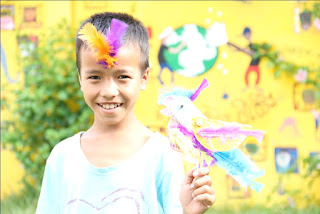
The second class I attended was a Sunday afternoon art lesson. Stepping through the doors of the newly built library, where classes are held on rainy days, meant stepping into a world of childhood imagination. A circle of children and adults suddenly became a menagerie of elephant, dog, tiger, and cat impressions. With little notice the animals transformed into a session of “head, shoulders, knees, and toes” followed by “the hokey pokey” to the joy of all involved. Next it was story time. Read in both English in Khmer, we were told the story of a little bird that left his home, had adventures, and finally found his way back to his family. The story led to the craft of the day, the construction of colorful paper birds complete with feathers, moveable wings, and googly eyeballs.
Having not stepped inside an art class since the end of my fifth grade education, I found myself a little rusty. Not only did my crayons wander frequently outside the lines, I had to sneak glances at the young boy sitting next to me in order to properly assemble my bird. In the end I was pleased with my product, enough so to hope my parents will find a prime spot on our home refrigerator to display my handiwork.
I left the school, bird in hand, and wondered if I had in fact done anything to help the children I had volunteered to assist. Their art skills far surpassed mine, my offers to help with the difficult parts of bird construction were met with silent stares, and attempts to take photos of their work resulted in frown-filled poses. As the wave of futility began to subside a new thought entered my mind, perhaps I was the student in the class. Across all cultures, as innocence is lost and maturity sets in, nothing is ever the same. In a country where people are often forced to grow up too fast, moments of childhood enjoyment are the most important to preserve. Sometimes the best thing to do for oneself is to stop being an adult and take the time to make a paper bird fly.
Define the word helicopter. Use only the simplest English vocabulary. Do not rely on the use of illustrations as an aid. Remember that the education of a group of five young students lies temporarily in your hands. It is not easy. Sitting in a classroom enveloped in the rush of humidity that follows an afternoon shower, ten fervent eyes fixed solely on their volunteer instructor, I had the task of defining “the flying machine with a spinning fan on top.”
The obstacle of defining several words that I take for granted in my everyday vocabulary was presented to me when I signed up to volunteer at one of Journeys Within Our Community’s (JWOC) conversation courses. During this time students are encouraged to attend and improve upon their English speaking skills. Unlike in America and other developed countries, in Cambodia the prospect of a sufficient education is not a right afforded to every young person. Public schools are inadequately staffed and underfunded. Students who wish to receive a proper education must seek out instruction elsewhere. This is where JWOC comes in, providing free classes for people of all ages in various subjects including the two I volunteered for, English conversation and art.
I have had a firm grasp of the English language since I mastered “Hop on Pop” in my pre-K years; however, I have never attempted to teach my native tongue. It was much harder than I ever could have imagined. After being placed in my small group I found my hand trembling as I filled in the correct answers on my worksheet. Fears of being a bad teacher suddenly seemed very real and all of my English speaking abilities left the room. At the moment of utmost panic one student looked at me and asked a question that immediately made me realize why I had come to that classroom.
“Can you read it to me? I want to hear all the words.”
This was something I could do. For the first time since entering the country I did not feel like a tourist, unaware of the lives unfolding all around me. I yearned to help these students to the greatest of my ability. Driven to this place of learning by their own desires, not by outside force, these young adults represent the heart of a developing nation. In their company I developed a strong admiration for the work they had put into their futures as well as an appreciation for the difficult yet rewarding job of teaching.

The second class I attended was a Sunday afternoon art lesson. Stepping through the doors of the newly built library, where classes are held on rainy days, meant stepping into a world of childhood imagination. A circle of children and adults suddenly became a menagerie of elephant, dog, tiger, and cat impressions. With little notice the animals transformed into a session of “head, shoulders, knees, and toes” followed by “the hokey pokey” to the joy of all involved. Next it was story time. Read in both English in Khmer, we were told the story of a little bird that left his home, had adventures, and finally found his way back to his family. The story led to the craft of the day, the construction of colorful paper birds complete with feathers, moveable wings, and googly eyeballs.
Having not stepped inside an art class since the end of my fifth grade education, I found myself a little rusty. Not only did my crayons wander frequently outside the lines, I had to sneak glances at the young boy sitting next to me in order to properly assemble my bird. In the end I was pleased with my product, enough so to hope my parents will find a prime spot on our home refrigerator to display my handiwork.
I left the school, bird in hand, and wondered if I had in fact done anything to help the children I had volunteered to assist. Their art skills far surpassed mine, my offers to help with the difficult parts of bird construction were met with silent stares, and attempts to take photos of their work resulted in frown-filled poses. As the wave of futility began to subside a new thought entered my mind, perhaps I was the student in the class. Across all cultures, as innocence is lost and maturity sets in, nothing is ever the same. In a country where people are often forced to grow up too fast, moments of childhood enjoyment are the most important to preserve. Sometimes the best thing to do for oneself is to stop being an adult and take the time to make a paper bird fly.
Subscribe to:
Posts (Atom)
